

Medical Assistant Vs. CNA: What’s The Difference?
Medical Assistants and Certified Nursing Assistants (CNAs) are two roles that are often lumped together. Many people think these two medical professionals are the same, but they are not.
Both occupations involve working with patients and collaborating with nurses and physicians in medical settings, but a CNA has more specific duties. It’s important to know these differences in order to make an informed decision about your future career.
To learn more about each role and to determine which profession is right for you, check out each section below for a more detailed overview.
- What Is A Certified Nursing Assistant (CNA)?
- Similarities And Differences Between CNAs And Medical Assistants
- What Are The Credentials For CNAs and Medical Assistants?
- Where Do CNAs And Medical Assistants Work?
- Which Role Is Right For Me?
The programs listed below will help you get started on your search to finding a school. These programs offer a variety of options for both working professionals and full-time students.
What Is A Certified Nursing Assistant?
A certified nursing assistant, otherwise known as a CNA, plays an important role in the medical field. CNAs assist nurses by doing patient prep work, such as taking a patient’s temperature or blood pressure, feeding and bathing patients, and filling the role of a general caregiver for patients who may not need constant medical attention, but do need assistance with personal maintenance in between medical procedures.
CNAs and medical assistants may work in similar settings and perform similar tasks even if their level of education and their requirements for licensure or certification are different. Duties of a CNA may include:
- Gathering Information: CNAs test vital signs, order blood tests, take temperatures, and ask questions of patients to form a dossier of information so that the nurse or physician can get right to the point when they see a patient.
- Keeping Records: Maintaining records of patient information is largely the purview of billing and coding specialists, but as the primary gatherers of certain types of private patient info, CNAs play an integral part in the medical data tracking machine.
- Bedside Patient Care: CNAs may need to care for disabled or anesthetized patients while they recover, sometimes on a continual basis. Patience and empathy are crucial skills to succeed as a CNA.
CNAs play a special role in keeping patients comfortable and safe, especially in nursing homes and long-term care facilities. The relationship between CNAs and their patients is an important one, as CNAs often spend significant amount of time assisting individuals with personal care and daily living tasks.
Similarities And Differences Between CNAs And Medical Assistants
If you’re having a hard time differentiating the two roles, you’re not alone. These positions share many of the same job duties, but each role has its own unique responsibilities and areas of expertise, as outlined below in the chart below:
| Job Title | Description | Licensing Requirements |
|---|---|---|
| Certified Nursing Assistant (CNA) | Nursing assistants, sometimes called nursing aides, help provide basic care for patients in hospitals and residents of long-term care facilities, such as nursing homes. Some nursing assistants also may dispense medication, depending on their training level and the state in which they work. | Nursing assistants must complete a state-approved education program in which they learn the basic principles of nursing and complete supervised clinical work. These programs are found in high schools, community colleges, vocational and technical schools, hospitals, and nursing homes. |
| Medical Assistant (MA) | Medical assistants complete administrative and clinical tasks in the offices of physicians, hospitals, and other healthcare facilities. Their duties vary with the location, specialty, and size of the practice. | Medical assistants typically graduate from post-secondary education programs. Although there are no formal educational requirements for becoming a medical assistant in most states, employers may prefer to hire assistants who have completed these programs. |
Most CNAs report to an RN or a licensed practicing nurse (LPN), whereas medical assistants report to an office manager or physician. Becoming a CNA requires more training than becoming a medical assistant; therefore, CNAs often have an easier time progressing into a career as an RN. CNA training may be applied to nursing school for partial credit at many colleges or universities, whereas medical assistants would likely need to start a nursing program from the very beginning.
A crucial difference between the two is that CNAs tend to provide bedside care to senescent patients, where medical assistants assist more with procedural or administrative preparation and housekeeping. Medical assistants assess and evaluate patients and assist physicians with the treatment and care of patients.
What Are The Credentials For CNAs And Medical Assistants?
Medical professions often require a certificate or credential that must be renewed every few years to ensure that the workforce is keeping up with innovations in the rapidly changing industry. For CNAs, this means completing 75 hours of state-approved training, and passing a competency test. Nursing assistants must also complete a brief period of on-the-job training to learn about their specific employer’s policies and procedures.
Most medical assistants are certified as well, as employers tend to hire medical assistants with some form of educational training. Programs for medical assisting are available from community colleges, vocational schools, and universities. These programs often take about one year to complete and require students to complete a laboratory component in anatomy and medical terminology.
It’s important to keep in mind that each state has it’s own licensing and continuing education requirements for CNAs and in some cases, for MAs. If you know which state you plan to obtain your license, it’s a good idea to research those requirements before applying to a certification program. These requirements include:
- How many classroom hours are required?
- How much clinical time is necessary?
- How many questions are in the written examination?
- How long the written examination will last?
- How to renew certification?
Again, each state is different, and it’s imperative you know how to become a CNA or a MA in your state to avoid state licensing or clinical placement issues.
Where Do CNAs And Medical Assistants Work?
Hospitals, private clinics, and doctors’ offices hire CNAs, medical assistants, or both. However, each facility is unique in its own way and may require CNAs and MAs to perform specific medical duties:
- Hospital Departments: CNAs don’t have to choose an area of specialization, but if a CNA wants to become a nurse, working in a specific department provides excellent on-the job-training. A CNA who wants to become a midwife might work in an obstetrics department to gain some experience and test the field.
- Family Practices: Medical assistants and nursing assistants can be crucial additions to small family practices, where one or two doctors are seeing many patients, and need to be free of administrative or routine tasks like taking weight, height, and vital signs.
- Nursing Care Facilities: Nursing care facilities are where CNAs are commonly employed. Nursing homes are also referred to as assisted living centers for the elderly and retirement communities. Medical assistants may also find employment
- Public and Private Outpatient Clinics: Some clinics specialize in a particular type of care, such as reproductive health or ambulatory surgery. These clinics can offer opportunities for both CNAs and medical assistants to gain assisting experience in a specific field, which can be useful for going back to school and trying to upgrade to a more prestigious career.
Urgent care clinics are growing in popularity and often hire CNAs and MAs to help busy nurses and doctors with their patients. CNAs may also work in rehabilitation programs or similar facilities and even in labor and delivery departments at hospitals and birthing centers.
Which Role Is Right For Me?
If you’re not sure which role is right for you, it may help to to learn as much as possible about all the different roles in the medical assisting field. CNAs and MAs are just a few of the many options available to you. If you’re looking for more administrative responsibilities, working as a medical assistant might be a better fit. If patient care and working with the elderly are more of interest, you’ll likely find the job a CNA more rewarding.
It’s also important to keep in mind a few important qualities many CNAs, MAs, and other medical aides often possess to determine if you’re a good fit for this profession. These roles require patience, stamina, interpersonal skills, and some level of technical acumen. Project management skills are also essential as are a passion for helping others.The type of patient you enjoy helping and the amount of hands-on care you wish to provide will determine which role is best for you.
The education requirements are different, and the options for career growth and pay increases also vary. The following list breaks down the requirements and options for each career path. There’s also the option to pursue other types of medical aide positions, such as a psychiatric aide, home health care aid, dental assistants, phlebotomists, just to name a few. CNAs and MAs are included in this list to serve as a comparison with other medical aide roles:
- Medical Assistant: Medical assistants a broad range of potential support jobs in medical facilities. No training or degree is required to have the title of medical assistant, but facilities have their own requirements for level of education and credentials for the medical assistants they hire.
- Certified Nursing Assistant: A college degree is not required to become a CNA, but 75 hours of training are required to gain certification, and the certification may need to be renewed periodically. This state-approved training qualifies CNAs for more responsibility and better pay than nursing aides or medical assistants.
- Physical Therapist Assistants and Aides: Physical therapist assistants, sometimes called PTAs, and physical therapist aides work under the supervision of physical therapists to help patients recovering from injuries and illnesses.
- Nursing or Psychiatric Aide: Psychiatric aides care for people who have mental illness and developmental disabilities and help patients in their daily activities.
- Medical Records and Health Information Technicians: Medical records and health information technicians organize and manage health information data, often in both paper files and electronic systems.
You’ll also want to consider job availability and which roles are in-demand. The chart below from The US Bureau of Labor Statistics illustrates the employment for the largest healthcare occupations. (Source: BLS.gov: Occupational Employment And Wages: Nursing Assistants, data as of May 2017.)
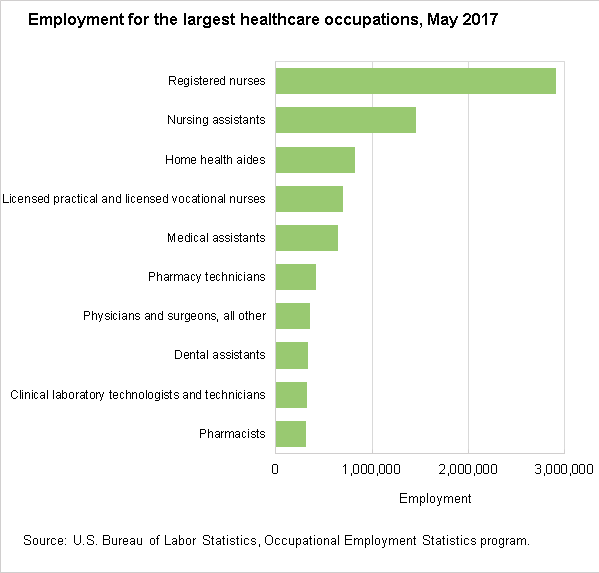
Many medical aide positions are in high demand, especially nursing assistants. If you choose to continue your studies to become a registered nurse, you’ll be in an even better position to find a job after nursing school.